Weekly writing about how technology and people intersect. By day, I’m building Daybreak to partner with early-stage founders. By night, I’m writing Digital Native about market trends and startup opportunities.
If you haven’t subscribed, join 70,000+ weekly readers by subscribing here:
Everything Is TV and Nothing Is TV
I’ve been thinking through where AI is headed in 2026, and I keep returning to two frameworks: everything is TV and nothing is TV. Let me explain.
Everything Is TV
One of my favorite essays from last year was Derek Thompson’s Everything Is Television. Thompson tracks how consumer internet companies become TV over time. Facebook, for instance, started by connecting you with your friends—remember the concept of “Friending” someone? How quaint. Today more than 80% of time on Facebook and 90% of time on Instagram (!) is spent watching videos. Thompson cites an FTC filing that sums it up well:
Only a fraction of time spent on Meta’s services—7% on Instagram, 17% on Facebook—involves consuming content from online “friends” (“friend sharing”). A majority of time spent on both apps is watching videos, increasingly short-form videos that are “unconnected”—i.e., not from a friend or followed account—and recommended by AI-powered algorithms Meta developed as a direct competitive response to TikTok’s rise, which stalled Meta’s growth.
Five years ago this week, I published an essay sharing my concentric circles framework on social media (The Evolution of Social Media). The gist of that piece was that social was moving toward rings 1 (messaging with close friends & family; e.g., WhatsApp) and 4 (broadcasting to strangers; e.g., TikTok). In the past five years, this trend has accelerated dramatically, as those FTC filing statistics make clear.

The point is: Meta products are now just television.
Thompson also points to podcasts. Gone are the days when you could show up to a podcast recording in your pajamas. An audio-only podcast? As if! While podcasts essentially started as a replacement for radio, they’re now more akin to going on Fallon or The View. Podcasts = TV. Consumption of video podcasts is growing 20x faster than audio-only podcasts, while over 50% of the top shows now release video versions. Given those tailwinds, you won’t be surprised to learn that YouTube, not Spotify or Apple Podcasts, ranks first for podcast consumption.
Speaking of YouTube: in my view, the best example for “Everything Is Television” is the rise of YouTube viewership…well, on a television. Netflix is a $415B streaming behemoth currently trying to gobble up Warner Bros Discovery. But Netflix isn’t even the biggest streamer on your TV! That would be YouTube:
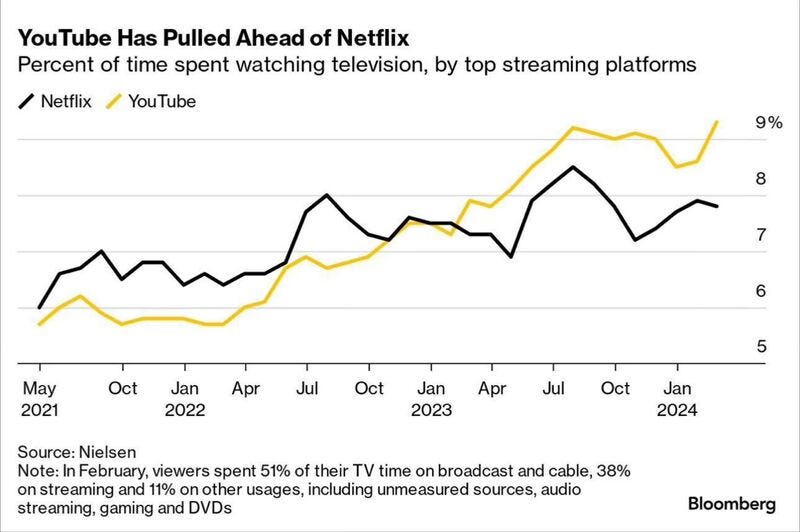
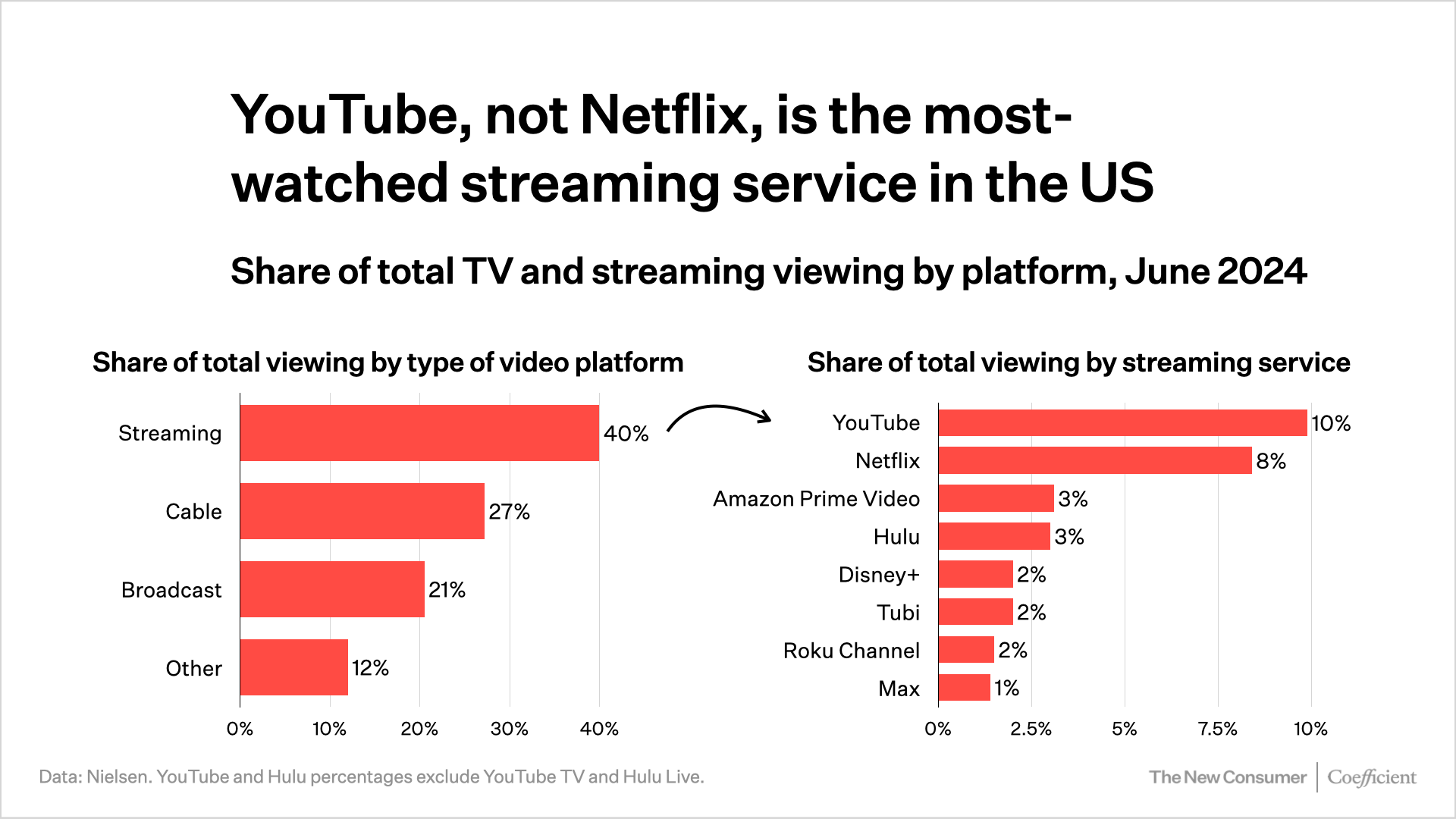
Your parents used to dismiss YouTube as “silly cat videos,” and now they watch NFL games on YouTube when not watching Joe Rogan on the big screen.
So how does this relate to AI?
When you think about what consumer AI will look like in a few years, you guessed it: it will probably look a helluva lot like TV. Some things never change, and one of those things is that humans like to watch other humans do stuff. From the thrilling (Stranger Things) down to the mundane (Dr. Pimple Popper), we like to watch each other; we’re social animals.
And the richer the media format, the better. The internet started with text (Twitter, Wordpress), then moved to photos (Instagram, Snapchat), and is now all about video (TikTok, Instagram again). The early internet couldn’t support rich media, but then we got broadband and 5G and GPUs and edge computing.
We’re seeing the same thing happen with AI. LLMs got us going. But image, audio, and 3D models are improving rapidly. Their leaps forward will underpin an explosion for generative media in 2026.
There’s a good chance that the breakthrough products will look a lot like TV. But I think we’ll see a few changes.
Ideas that will soon be possible in generative media:
Prompt-to-Series Studios: A single sentence (“Succession, but for crypto founders in Miami”) spins up a full season with characters, arcs, cliffhangers.
Participatory Media: “Sex and the City, but starring our college friend group” or “The Avengers, but starring our family” brings you into the story. You’re also in charge of the narrative, making Netflix: Bandersnatch look like the Stone Ages.
Generative Kids Shows: Stories that adapt to a child’s age, interests, and emotional development; personalized Sesame Street or Bluey or Magic School Bus.
Creators → Worldbuilders: Creators publish entire universes, which fans can explore; you can be a lurker (watching passively) or an active participant. This has flavors of Minecraft or Roblox but with the fidelity and polish of an HBO show.
Never-Ending Shows and Games: This goes back to the Jensen quote: “Every single pixel in a video game is going to be generated, not rendered.” This completely rethinks the way stories are told. Stories will probably still have endings (endings make for a good story), but you’ll be able to keep playing past the end if you want to. When there’s no production budget and things are generated in real time, why stop?
You get the picture.
“Media” is a bad word in venture circles. When we think media, we tend to think Buzzfeed and Vox. We forget that Meta is $1.6T market cap media company, or that YouTube would be worth $500B if independent from Google. The biggest companies in the world are media companies. They just need once-in-a-generation technology shifts to be founded.
I’m a media-obsessive, but we hardly have a media company in the Daybreak portfolio. It’s not for a lack of looking! The tech hasn’t quite been there, until this year. Models are now improving, and the culture-defining applications will follow.
When you think about where consumer AI is headed in 2026, a good rule of thumb to remember: everything is TV.
But Nothing Is TV?
Now for framework número dos. Arguably the most-cited chart in Digital Native history is this chart, showing the price change in goods and services over time:
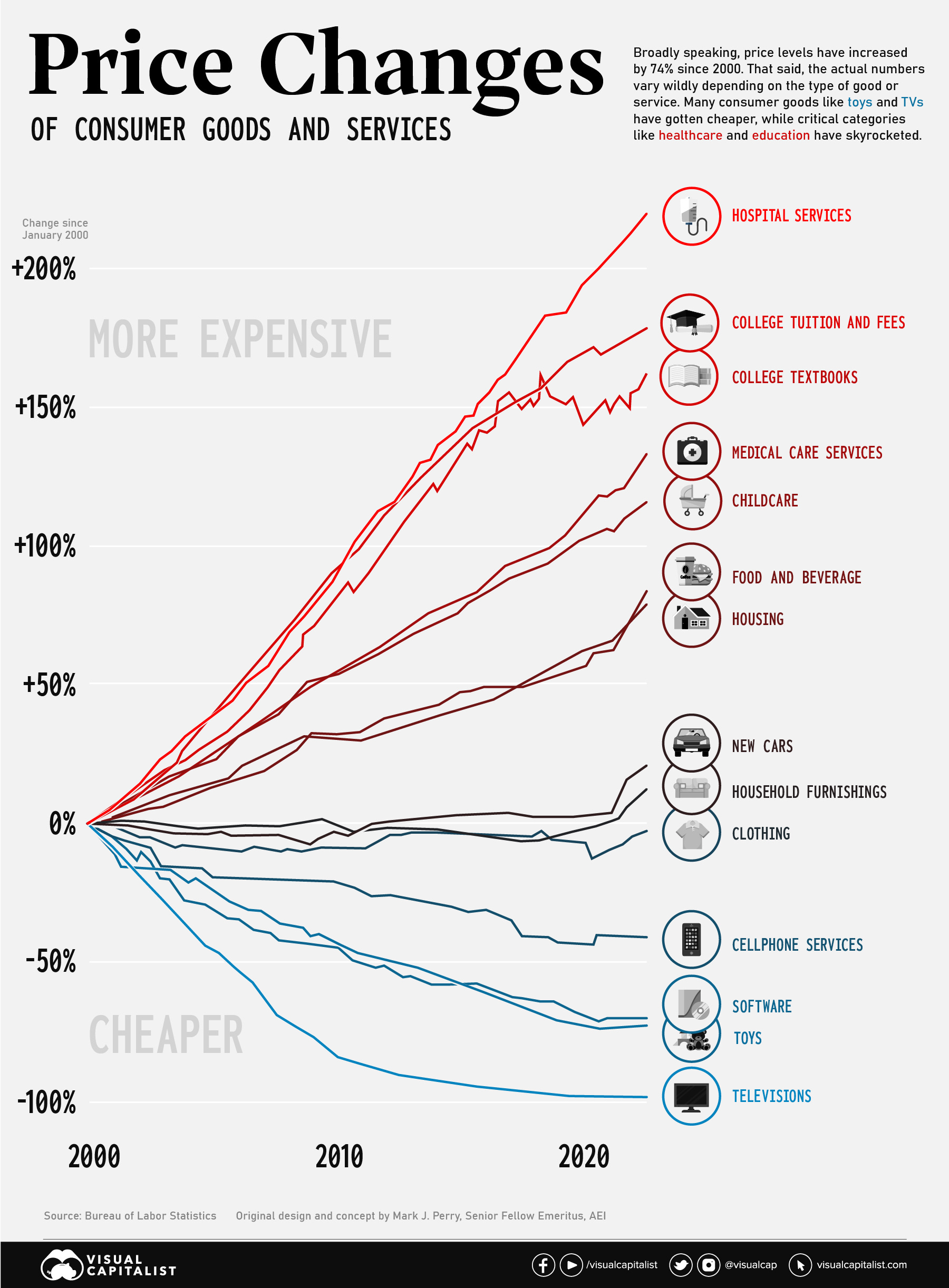
Many of America’s problems can be traced back to this chart. Waning homeownership among Millennials and Gen Zs? Yup. Healthcare’s affordability crisis? Bingo. Crushing student debt? You’ve got it. In many ways, this chart tells the story of America over the past 25 years.
You’ll notice the line at the very bottom of the chart—televisions. Why is the cost of a TV down 98%, but the cost of hospital services has tripled? This is where the “Nothing Is TV” framework comes into play. How do we make more more stuff like TVs in this chart? The answer is AI.
This might sound far-fetched to AI skeptics. Shouldn’t we have, you know, better policies for housing and healthcare? Yup, we should. But we don’t. Our society has a history of innovating our way out of messes, and this time won’t be any different. AI, with the proper guardrails, can massively reduce costs.
This is the “services-as-a-software” thesis, with AI augmenting and automating expensive labor and manual workflows. Can healthcare be more affordable if the $1T spent on admin overhead is lessened? Let’s hope so. Can housing become more affordable if we automate away a bunch of grunt work? Probably—with robotics will also play a role for physical world industries.
“Nothing Is TV” is one of my guiding frameworks for 2026. While “Everything Is TV” is more B2C-focused, “Nothing Is TV” skews B2B. It’s relevant in almost every industry: AI should drive down costs by an order of magnitude, reinventing industries front to back.
The final point I’ll make is The Jevons Paradox. Back in the 1800s, the English economist William Stanley Jevons found that efficiency improvements in coal, driven by better technology, led to increased demand for coal across industries. This is the paradox: efficiency gains tend to increase, not decrease, demand.
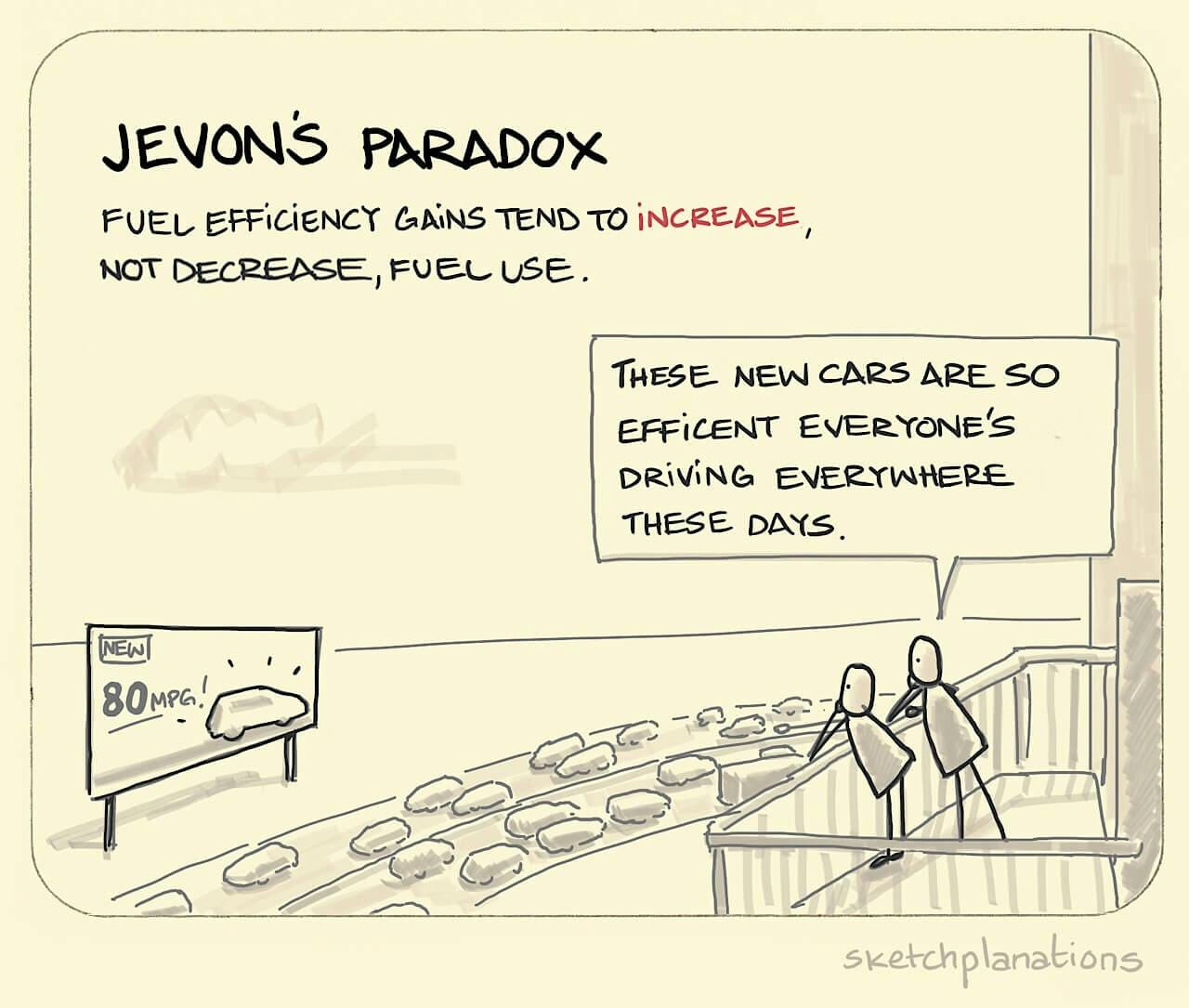
Aaron Levie wrote a good blog post over the holidays about how The Jevons Paradox applies to AI. AI makes everything more efficient, cheaper. This means demand will go up not down. Take the legal industry. Does AI mean that less gets spent on lawyers? No, it means that more people have access to legal expertise, and the market will expand dramatically.
We’ve seen this before. As Levie puts it: “While you would have to have been a Fortune 500 company to access powerful software to do your accounting in the 1970s, by the 2000s with the cloud, it was available to every barbershop in the world.” He later frames it this way: “AI agents fundamentally change the calculus here. Now, we can dramatically lower the cost of investment for almost any given task in an organization. The mistake that people make when thinking about ROI is making the ‘R’ the core variable, when the real point of leverage is bringing down the cost of ‘I’.”
Bingo. The “I” is the cost in the chart above. This is as good an argument I’ve heard for reversing the chart’s trendline of rising prices. Today nothing is like TV; everything is getting more expensive, not less. Hopefully we can soon turn the tide.
These are two phrases I’m going to be repeating to myself a lot this year. When it comes to consumer, everything is TV. And when it comes to enterprise, nothing is TV (for now).
See you next week 👋
Thanks for reading! Subscribe here to receive Digital Native in your inbox each week: