

Weekly writing about how technology and people intersect. By day, I’m building Daybreak to partner with early-stage founders. By night, I’m writing Digital Native about market trends and startup opportunities.
If you haven’t subscribed, join 70,000+ weekly readers by subscribing here:
Before this week’s piece, I want to emphasize: it feels strange to write about tech when our country feels so fractured. Topics like AI adoption and startup disruption are important and timely, yet they pale in comparison to human rights and human lives. This isn’t a political publication, but it is a publication about technology and humanity—and it feels important to say the latter comes first.
Oxygen Monopolies
One of my favorite charts every year is this one, which Axios puts out each December:
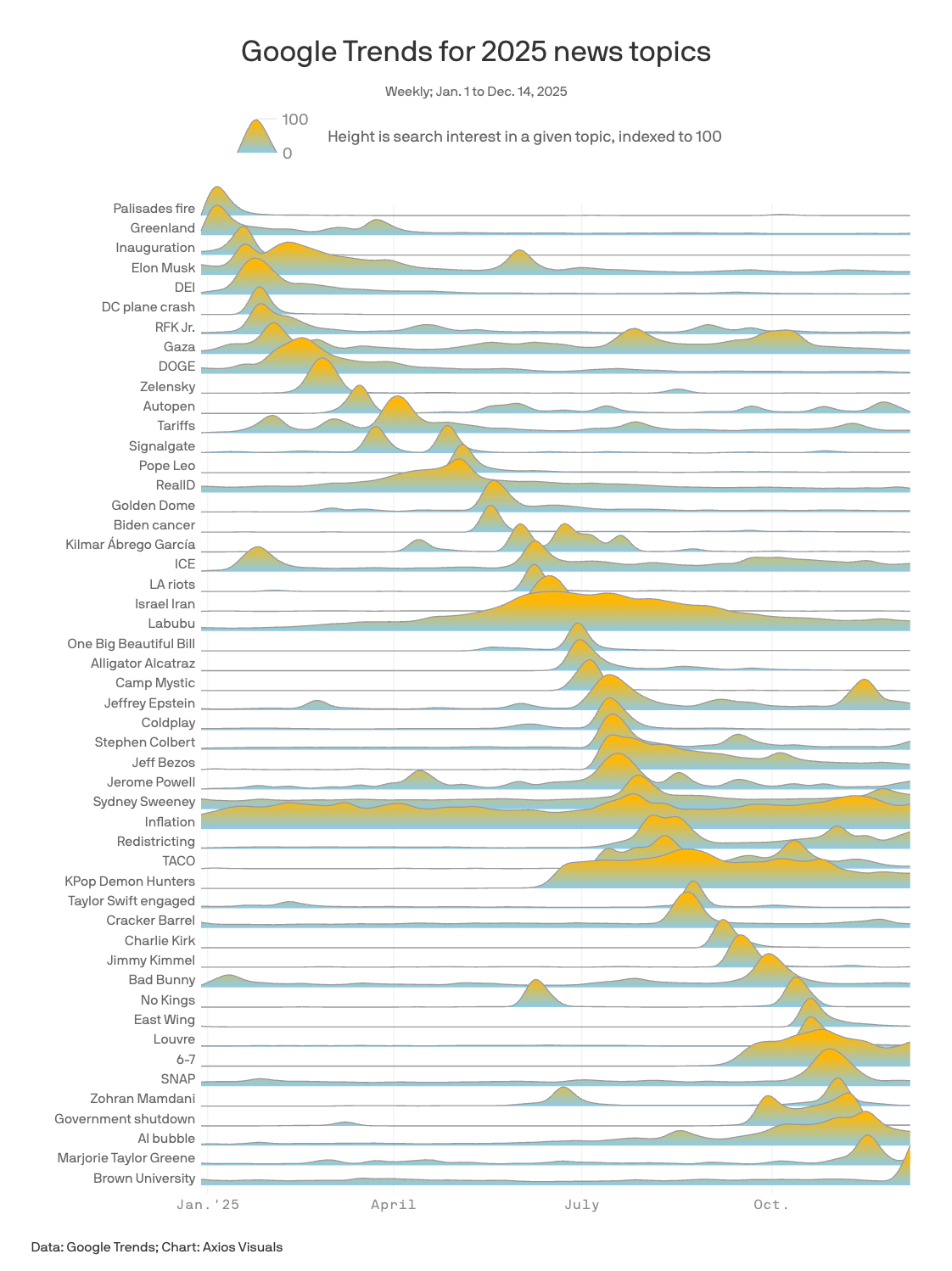
This chart does a good job reminding us how fast news cycles move in today’s world. Other than inflation and (surprisingly?) Labubu, most stories spike then fade away.
Take the capture of Maduro. The US extracted a world leader from his country in a covert night operation (!) and it dominated the news for, what, a week? Insane. I saw a tweet that wondered how long the OJ Simpson trial would stay in the headlines in today’s media environment. A week? A day? It’s an interesting question to ask.
Andy Warhol is famous for saying that one day everyone would be famous for 15 minutes. The internet made that true, and if the internet is the vehicle, AI is the accelerator.

The challenge for startups is: how do you stay top-of-mind in an oversaturated, fast-moving media environment? How do you build a cohesive brand that remains top-of-mind and communicates a clear and consistent value prop? If the world moves fast these days, startups move at warp speed.
We’ve never seen anything like the pace of AI, and fast-moving news cycles and fast-forming opinions are dictating real startup outcomes. While momentum is most certainly not a moat, going from $0 → $10M+ ARR in under a year is more and more common. Charts like these continue to compress:
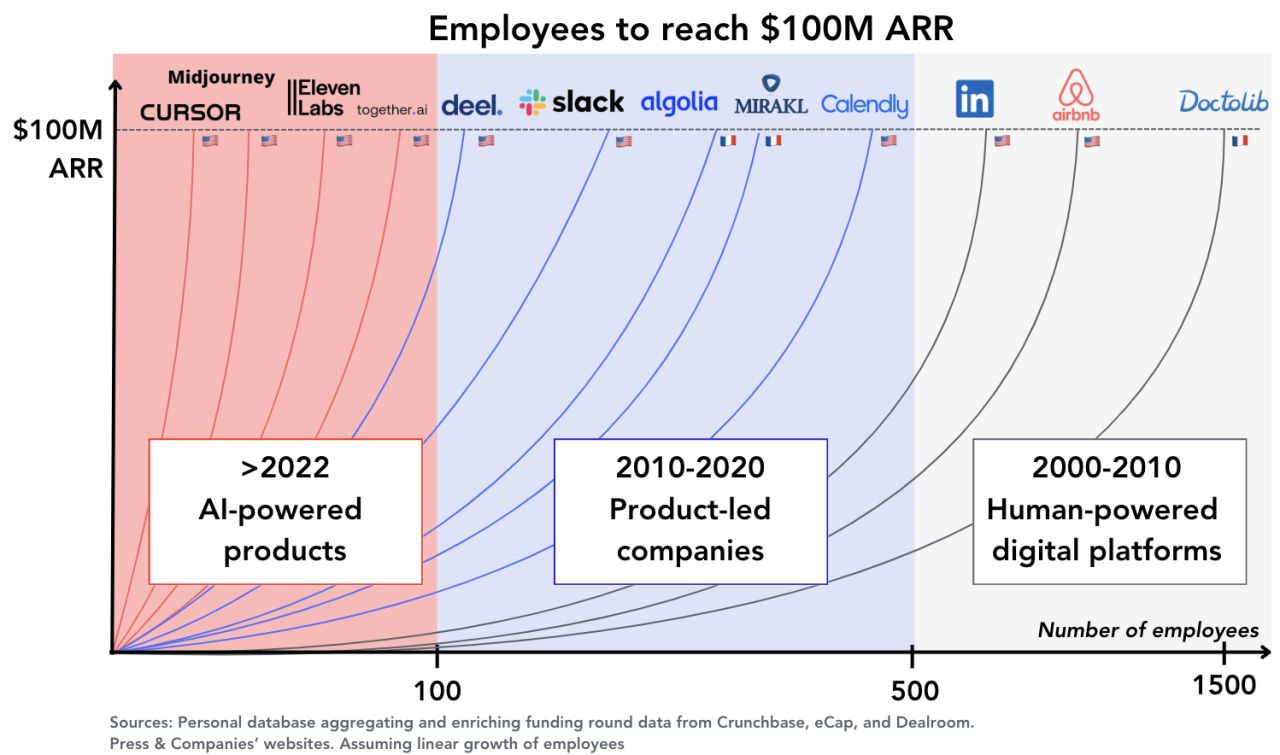
When markets move faster than ever, narratives also take shape faster than ever. Companies become synonymous with nascent categories and winners are crowned even as a category remains in its infancy.
This is an enormous challenge for founders, but it’s also an opportunity. There are a few things that founders can do:
1) Build incredibly simple brand association with your category—early.
Savvy companies become synonymous with a category as early as possible. Probably the best example in applied AI is Harvey in legal AI.
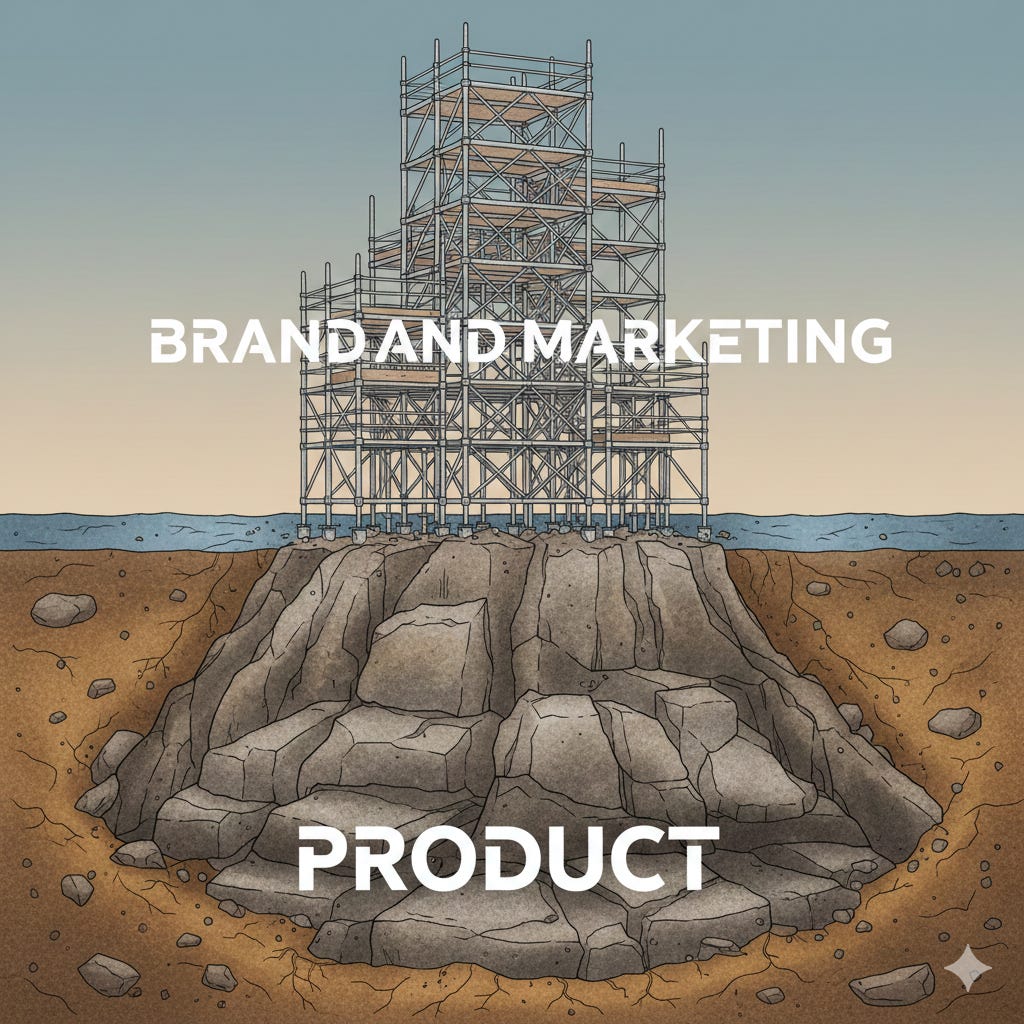
Harvey was early to the category: Gabe and Winston cold-emailed OpenAI, which led to them becoming one of OpenAI Startup Fund’s first investments. The founders saw where law was going, with excellent foresight. But they also pulled off a masterclass in marketing. Harvey became synonymous with legal AI when the category was barely born. Even though Legora is reportedly catching up, Harvey still sucks up most of the oxygen in the market. Great product is a pre-requisite for a strong brand (think of it as the foundation upon which GTM + brand get built) but savvy brand positioning can dictate how high a startup can rise from there.
I envision it like bedrock + scaffolding. Here’s a nice visual, courtesy of Gemini:
VCs, of course, play a key role in kingmaking, especially in a hot market where capital and talent fast-follow top VCs.
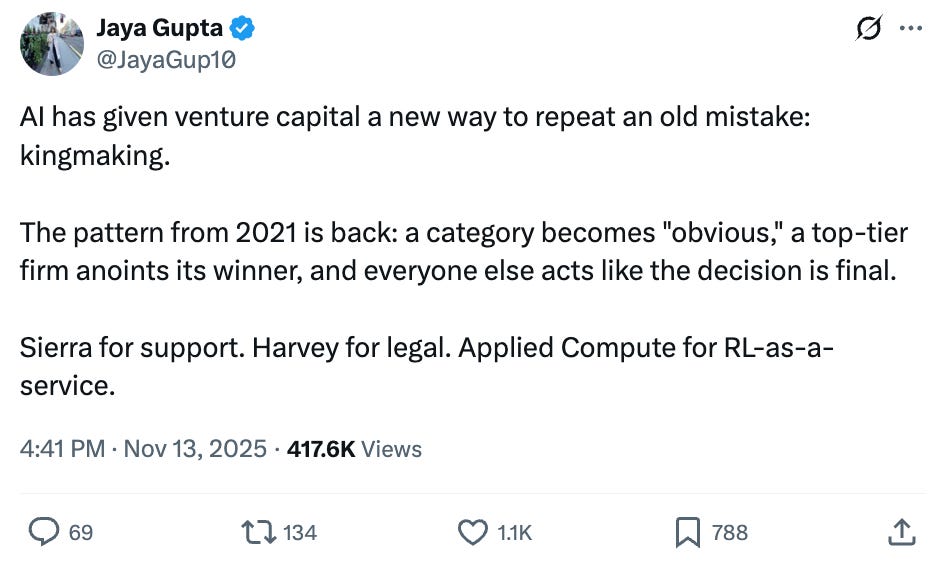
Is this the ideal way venture should be done? No. But it’s a real phenomenon, and smart founders understand it and use it to their advantage.
Marketing and brand are often dismissed, typically by engineering- and product-oriented teams. Marketing and brand are fluffy, abstract; eng and product are concrete. But in today’s AI landscape, savvy marketing and brand matter a lot. Look down on them at your own risk.
A company should aim for a clear brand association. Companies that have done a good job:
Harvey = AI for lawyers
Listen Labs = AI for user research
Profound = AI for brands (GEO)
At most law firms, chances are someone is saying, “Hey are we using Harvey? I keep hearing about them.” Buying Harvey becomes synonymous with buying innovation, with staying bleeding-edge. You’re buying peace-of-mind as much as you’re buying ROI-boosting software. This clear association, when paired with good product, becomes a winning formula.
Side note: you don’t have to be the first-mover to do this well. Brex had a two-year head start on Ramp, but Ramp now does ~2x Brex’s total payments volume (TPV). Ramp had both (1) the better product, and (2) masterful marketing. The first is the pre-requisite, the bedrock, but the latter helped Ramp hit escape velocity.
In our 2023 piece How to Build Your Startup Brand, we covered how Ramp tapped Red Antler to come up with a fresh fintech brand. From that piece:
When Red Antler began working with Ramp, Ramp was looking to disrupt the corporate card market. The corporate card world is dominated by established players that are associated with status (cough, Amex, cough). Ramp needed to do something different.
Ramp’s strategy became, “Smart is the new platinum.” The founders and Red Antler realized that today’s businesspeople are less concerned with dropping the corporate card at the steak lunch, and more concerned with visibility, control, and data. They want to spend less and they want to spend more intelligently. Flagrant spending is out; smart, sustainable growth is in. Ramp’s brand strategy leaned into these insights.

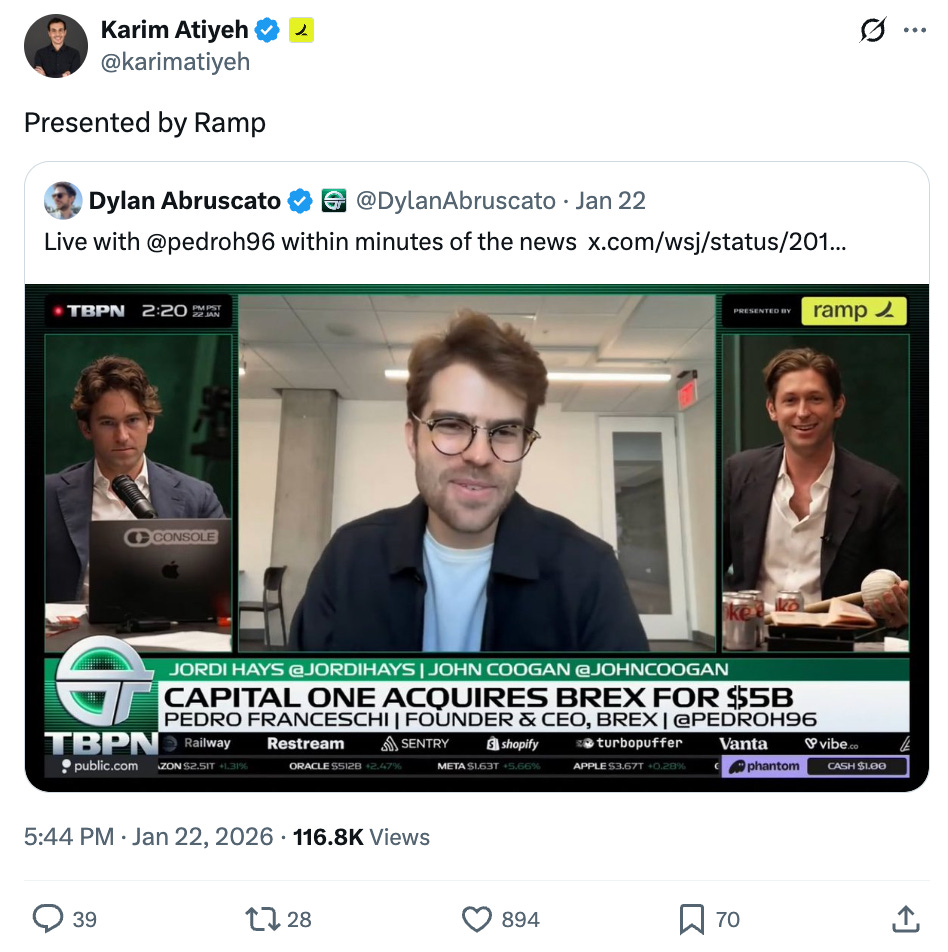
The rest has been great execution. Ramp is now synonymous with its category. Case in point: Brex’s founders went on TBPN to talk about the Capital One acquisition…and TBPN is presented by Ramp:
2) Suck up oxygen in your category before someone else does. This typically means telling your own narrative.
Sometimes you’ll hear founders say they don’t want to talk about their company because they’re worried about competition.
I generally don’t believe in building in secrecy. For the 1% of companies with true proprietary tech or advantages, this might be the right approach. For the other 99%, the advantages of telling your story outweigh any advantages of secrecy. I also generally believe that ideas are commodities and success is determined by better execution. Google came after Altavista, Facebook came after Friendster, DoorDash came after GrubHub, Amazon came after Ebay, and so on.
If you don’t position your company within your category, someone else will start sucking up all the oxygen. That’s a real risk. You don’t earn points for mystique when there’s a marketing knife fight happening in real time.
I also like how Michael Dempsey frames narrative entry-points. The more saturated your category becomes, the more specific your narrative must become:
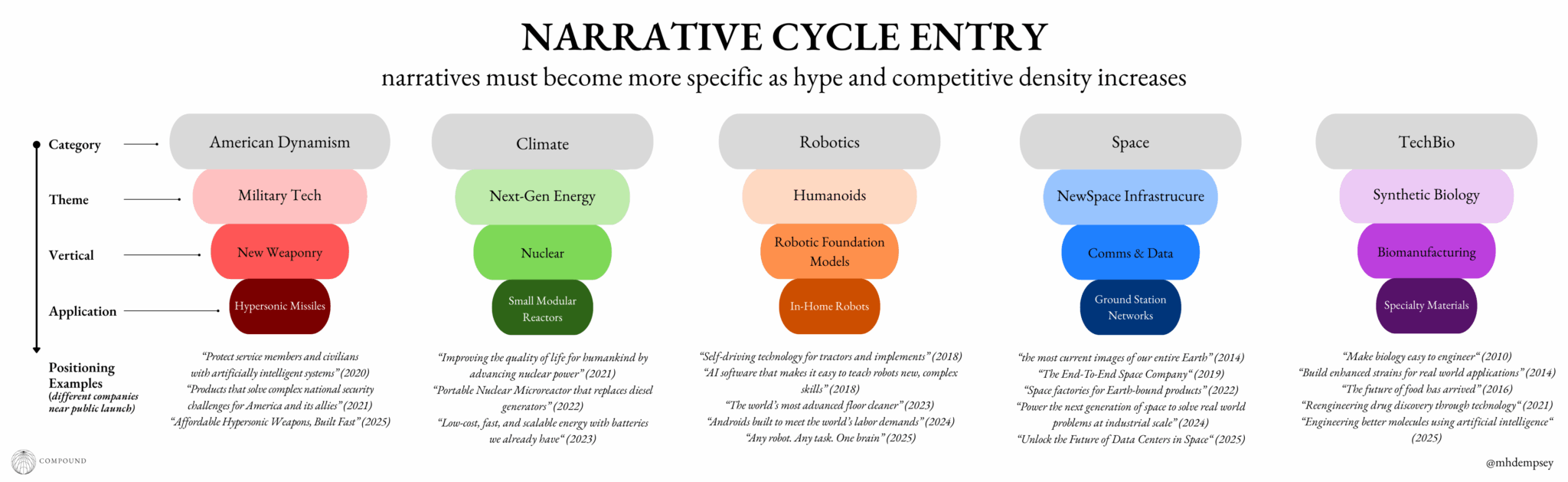
By this measure, it’s better to be early—so make this is a priority from the get-go.
3) Hire a growth marketer earlier than you think you should.
More tactically: hire a growth marketer!
In the past, the first dozen employees of a startup might be entirely engineers. Those days are gone, in my mind. Founders benefit from a growth marketer early, to think through and execute everything above.
I also think that in today’s AI world, the founding DNA of a company (or at least the DNA of the early team) has changed. As technical barriers lower with coding agents, distribution, brand, and marketing matter more. You should probably have a growth / brand wizard among your first hires, particularly if that skillset is lacking on the founding team.
We’re hiring at Daybreak! 🌄
On that note: I should probably walk the walk here on my own advice. At Daybreak, we’re basically a Seed-stage startup—maybe Series A. So we should probably tell our narrative, with means bringing on the right people to help us do that.
I’ve been saying that 2026 is about turning from fund to firm. We’re growing up!
We have a new partner joining next week on the investing side (more on that soon), and we’ll hire for a couple roles on the platform side. I want us to be very intentional with what the Daybreak brand stands for.
In a recent memo to our LPs, I wrote the following:
We believe that venture is a services industry, and services don’t scale. Some firms position themselves as engines of scale, while we position ourselves as the opposite. We do things that don’t scale, intentionally: we give our founders tailored resources and attention toward finding product/market fit and getting their company off the ground. This is why founders choose us.
This month Andreessen Horowitz announced $15B in new funds. a16z is known for basing its business model partly on the business model of CAA, the Hollywood talent agency. This has worked incredibly well: a16z has built a formidable machine and transformed the venture landscape. We respect what they’ve built tremendously, even if we don’t always agree with it.
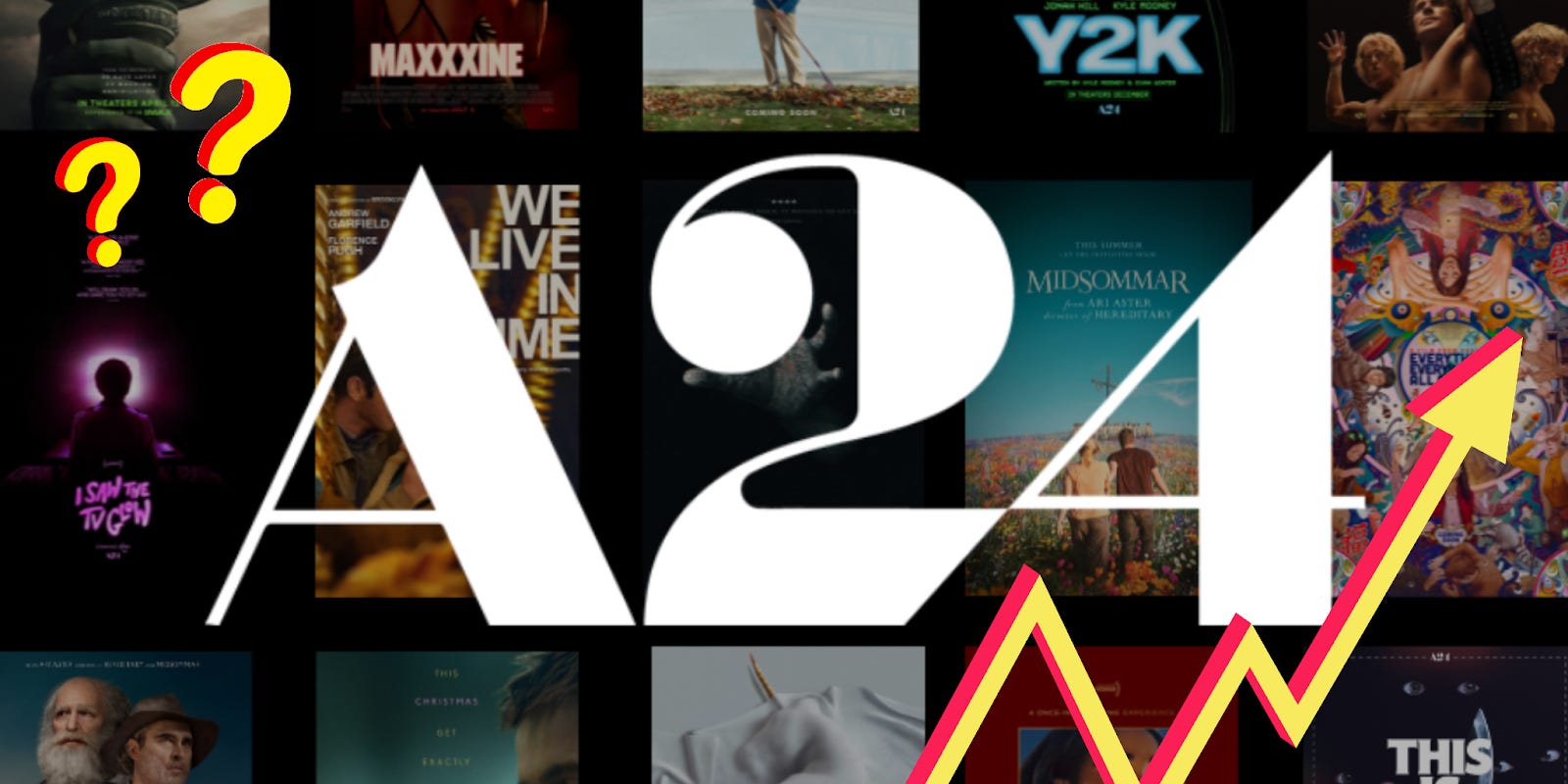
We aren’t designed to look like CAA; we are designed to evoke A24. We aren’t pursuing scale, but are instead pursuing craft. Directors choose A24 because they know that A24 has taste and style, because they know A24 is hands-on and committed to realizing the director’s vision. They also choose A24 over larger studios because A24 stands for something very specific; they’re proud to tell their spouse they got A24, and they know A24 will be a magnet for attracting the best cast and crew.
Anti-scale wins at Pre-Seed and Seed because founders want a partner who has craft, focus, and taste. Founders can take multi-stage capital at Series A; we’re friends with all those folks, and we’ll help them do it! But they can only work with Daybreak once. By working with us as their first investor, they get something specific and sought-after: time and effort, intentionality, deep expertise in zero-to-one company building.
I’m a huge movie buff, so I was proud of the A24 analogy :) It’s a good North Star. I think A24 probably has the clearest brand in the world right now, across every industry. They’ve done an incredible job. How do we replicate that in venture? The old playbooks are stale and the industry is more saturated than ever. We want to shake things up a bit.
To that end, we’re hiring for two roles:
1) Head of Editorial
This person focuses on how we design and grow the Daybreak brand. This means content, marketing, and new creative initiatives. How do we build out Digital Native in interesting ways? Do we launch a new publication or two? Should we revamp our website? Maybe do a video series on our founders and their stories?
We have a lot of ideas; we just need to refine them and execute on them. That’s what this person will be in charge of. The role is New York-based and will be multimedia (writing, audio, video, etc).
To take our own advice from earlier, we need a crystal-clear brand association. Words we use a lot: artisanal, craftsmanship, company-building, people-centric, anti-scale, quality > quantity. How do we turn this word cloud into a cohesive brand? That task falls to this role.
If you’re interested in this role, or know someone who would be great, we’d love for you to fill out this Google Form:
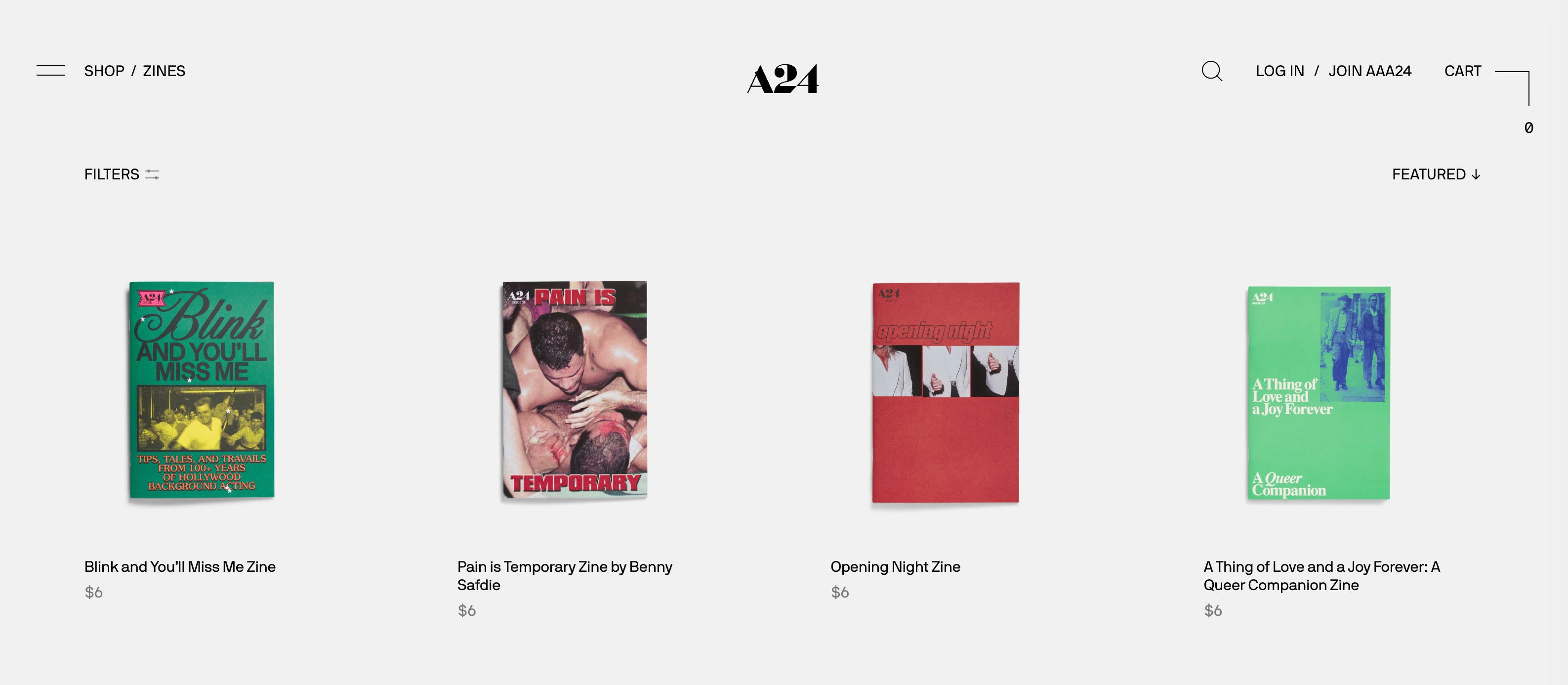
To give a good example of A24’s creativity here: A24 offers short-form magazines through its online Zines shop. What’s the Daybreak equivalent?
2) Head of Experiences
If Head of Editorial focuses on how Daybreak shows up online, this role focuses on how we show up offline. You’ll craft IRL meet-ups, events, and community. You’ll work in close concert with the Head of Editorial, but focus on translating our online identity into tangible IRL experiences.
Example questions to answer: What should a Daybreak speaker series look like? What about Demo Nights or a Hackathon? How do we best cultivate and grow our networks? This person will be tasked with answering these. The right person is probably deeply persnickety with great attention to detail, and the ever-elusive “taste.”
Here’s a Google Form for this role:
What’s the A24 analogy here? Well, I’m not sure we need the full-on Marty Supreme blimp, but what’s our equivalent of the underground ping pong matches A24 has been hosting for the movie’s promo? We want to figure that out.

Both roles are NYC-based. Relevant experience is less important than creative thinking + high hustle. We’d rather someone come to venture with a fresh perspective and breathe new life into a tired, saturated industry with familiar playbooks.
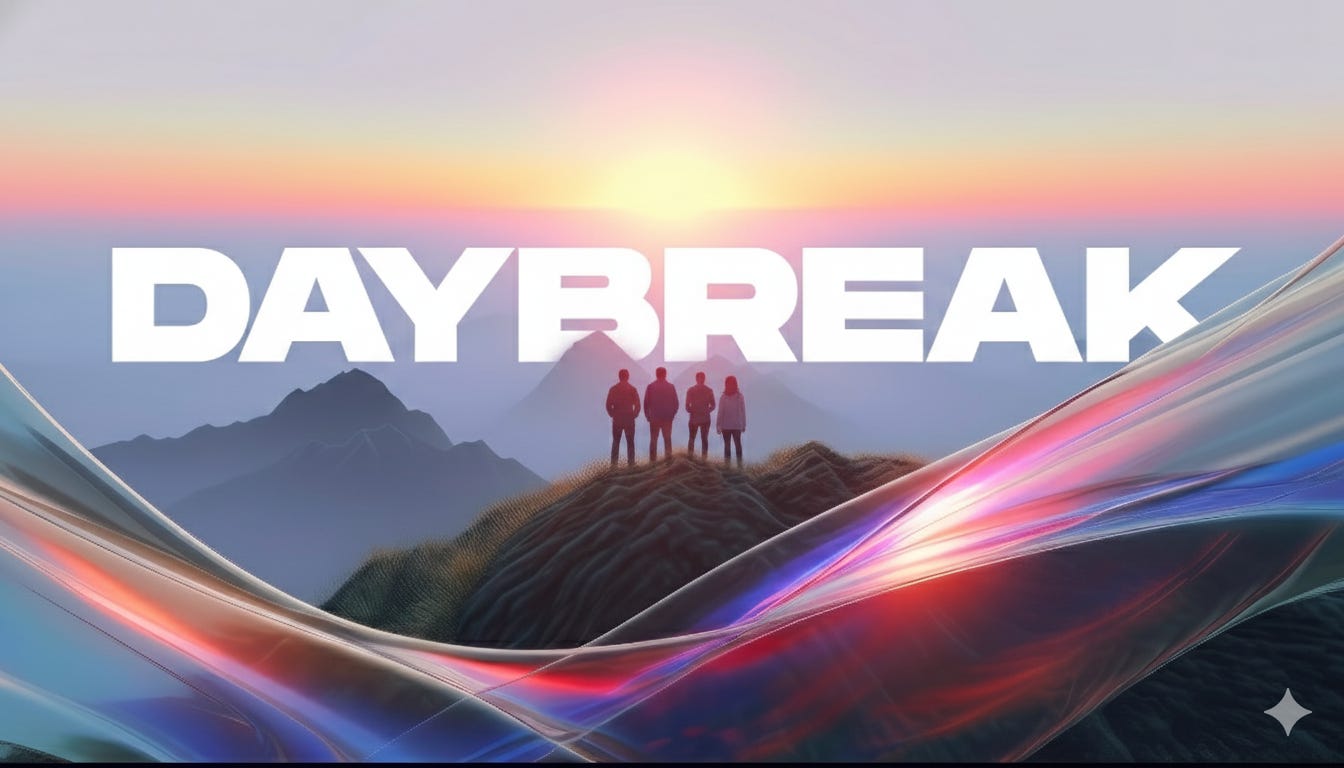
The cover of our Fund I deck showed an image of a man overlooking sunrise, which I made with Midjourney. I recently asked Gemini to update it by adding a few new people. Our team is (finally) growing!
Hopefully putting the word out about these roles leads to some good serendipity and new members of the Daybreak team! 🙏
Final Thoughts: Tide Detergent and Staying Top-of-Mind
My dad used to say a Woody Allen quote: “Eighty percent of success in life is showing up.” It’s directionally true. Applied to the startup world: eighty percent of success is getting people to think of you. When I think about oxygen monopolies—the companies that suck up the oxygen in their category—they accomplish just that: they make people think of them.
An old Ben Thompson piece digs into Procter & Gamble marketing. Before the internet came along, Procter & Gamble only needed to market Tide so that a customer would recognize the orange packaging on the grocery shelf. Easy enough!

But post-internet, P&G needed to get that consumer to type the word “Tide” itself—otherwise, top hits for detergent might be for competitors or for Amazon private-label products. Brand recall, as opposed to brand awareness, is a much more difficult and expensive proposition. Although Tide dominates the U.S. laundry detergent market (41% market share, more than the next five brands combined), when I search “laundry detergent” on Amazon I don’t see Tide anywhere. Tide doesn’t show up until the 9th hit!
This is a good example of how brand has shifted: you need to get people to proactively think of you. For Daybreak, this means making sure founders think Daybreak when they start their company. Brand is hard to measure, but one measure of success: in five years, when you poll founders on which VCs they’d most want to lead their Seed round, is Daybreak among the handful of names mentioned? There are 14 million venture firms out there, so it’s a formidable challenge.
Same for startups. You want to replicate the lawyer saying “Are we using Harvey?” This is why Sandstone’s launch earlier this month was important, and why we wrote about it in The Year of Invisible AI. Sandstone needs to be synonymous with in-house legal AI. Every applied AI company should be thinking about how to articulate themselves clearly, crisply, and consistently. In a startup world that’s the equivalent to the 24/7 news cycle, how do you build a cohesive long-term narrative?
Clear brand positioning matters: narratives form faster than ever, and they calcify. Once they’re hardened, they become hard to change. The illusion of success then begets real success.
Thanks for reading! Subscribe here to receive Digital Native in your inbox each week: